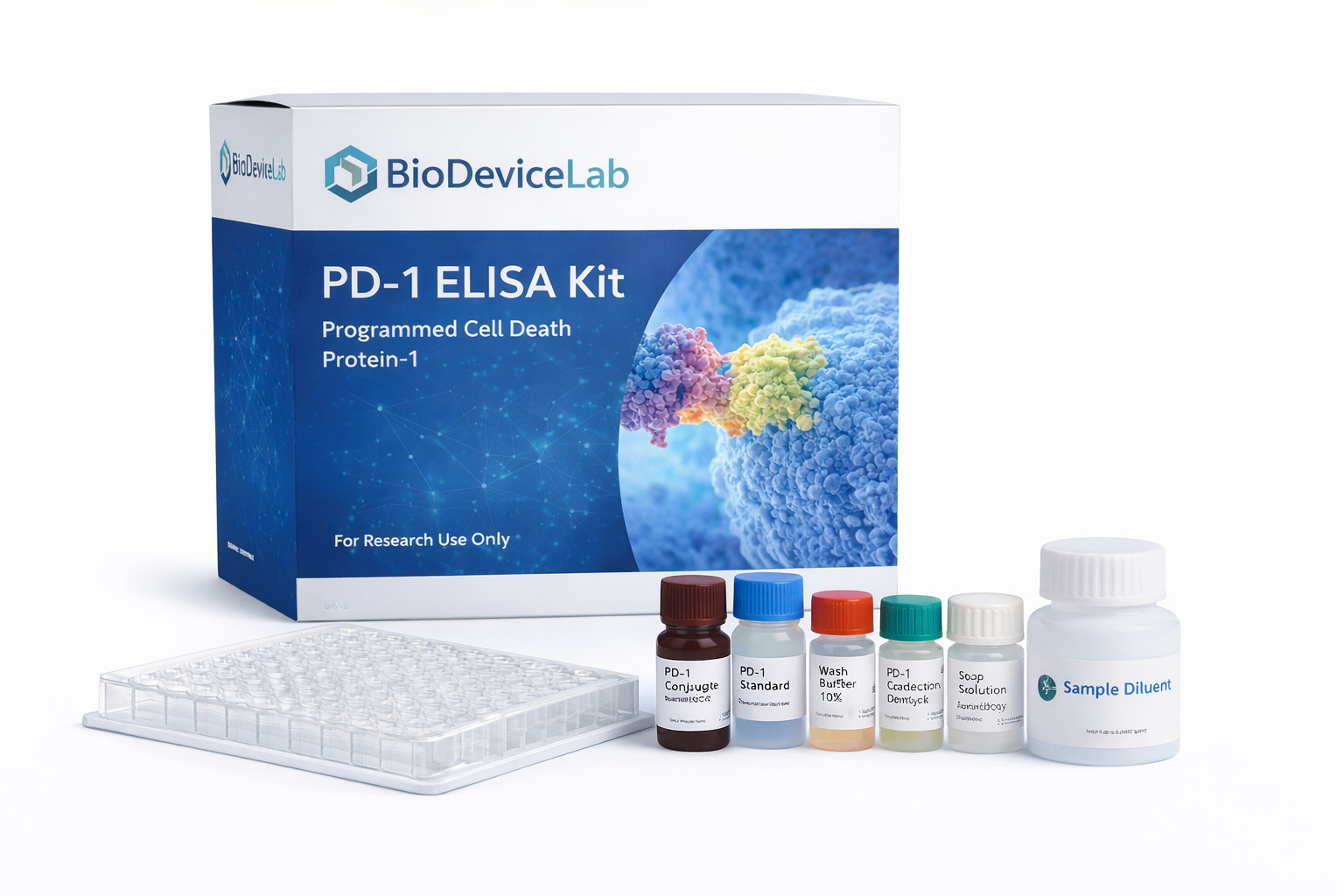
The BioDeviceLab PD-1 ELISA Kit is a high-performance sandwich enzyme-linked immunosorbent assay designed for the quantitative determination of soluble PD-1 (sPD-1) in biological samples. PD-1 is an immune checkpoint receptor expressed on activated T cells, B cells, and myeloid cells and plays a central role in immune regulation, T-cell exhaustion, and cancer immune evasion. Circulating PD-1 levels are increasingly investigated as biomarkers in immuno-oncology, autoimmune disease, chronic infection, and immunotherapy response monitoring.
For Research Use Only (RUO).
Intended Use
This kit is intended for the quantitative determination of soluble PD-1 in:
• Serum
• Plasma
• Cell culture supernatants
Applications include immuno-oncology research, immune checkpoint pathway studies, immunotherapy response monitoring, organ-on-chip immune models, and biodevice validation and calibration.
Assay Principle
This assay employs a sandwich ELISA format:
• Soluble PD-1 in the sample binds to capture antibodies immobilized on a 96-well microplate.
• A biotinylated detection antibody specific to PD-1 binds to the captured protein.
• An enzyme conjugate is added, followed by a chromogenic substrate (TMB).
• The enzymatic reaction generates a color signal measured at 450 nm.
• Absorbance is directly proportional to PD-1 concentration in the sample.
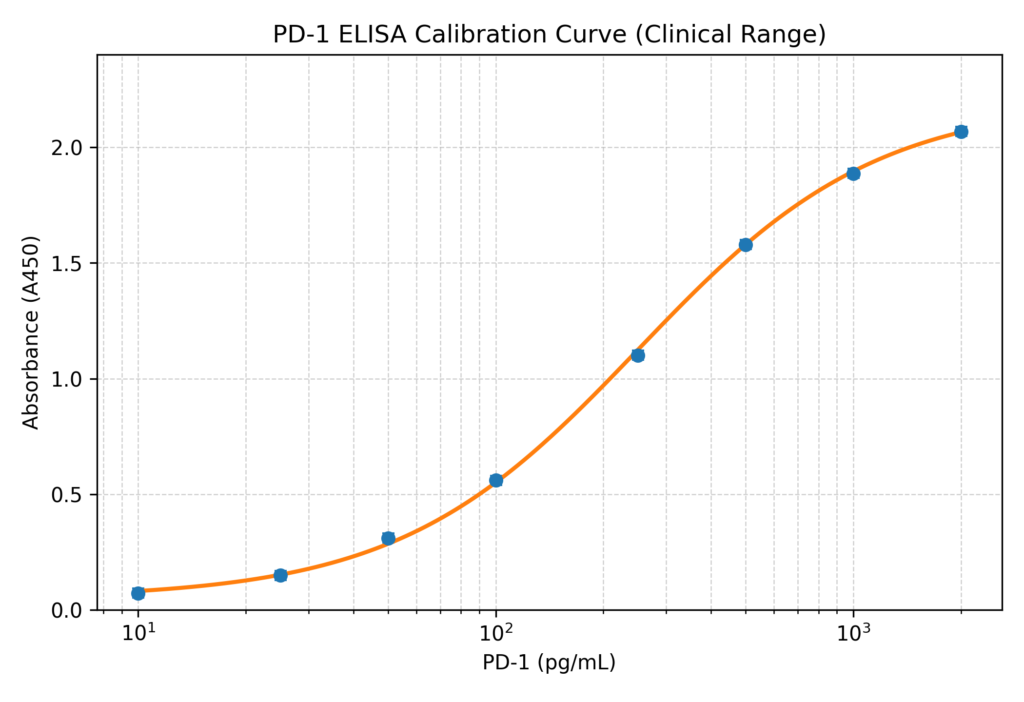
Calibration Curve
• A calibration curve is generated using PD-1 standards with known concentrations.
• Mean absorbance values are plotted against PD-1 concentration on a semi-logarithmic scale.
• A four-parameter logistic (4PL) regression model is recommended for curve fitting.
• Sample concentrations are determined by interpolation from the standard curve.
• A new calibration curve should be generated for each assay run.
Analytical Performance
Dynamic detection range: 10 – 2,000 pg/mL
Limit of detection (LOD): ≤ 5 pg/mL
Intra-assay CV: < 10%
Inter-assay CV: < 12%
Selectivity & Specificity
The assay demonstrates high specificity for human PD-1 with minimal cross-reactivity to related immune checkpoint proteins. Representative cross-reactivity levels:
• PD-1: 100%
• PD-L1, PD-L2, CTLA-4: < 1%
This ensures reliable PD-1 quantification in complex biological matrices.
Applications
• Immuno-oncology and immune checkpoint research
• Cancer immunotherapy response studies
• Immune activation and exhaustion profiling
• Organ-on-chip immune and tumor models
• Biodevice calibration and benchmarking
Calibration Curve