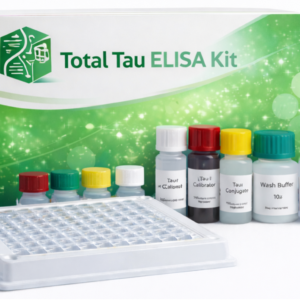

Product Overview
The BioDeviceLab Human Calprotectin ELISA Kit is a high-performance enzyme-linked immunosorbent assay developed for the quantitative determination of calprotectin, a heterodimeric complex of S100A8 and S100A9 proteins predominantly released by activated neutrophils and monocytes. Calprotectin is a well-established biomarker of intestinal inflammation and mucosal immune activation and is widely used in both translational research and clinical studies.
In the gastrointestinal tract, calprotectin reflects neutrophil infiltration, epithelial injury, and inflammatory burden and correlates strongly with disease activity in inflammatory bowel disease and infection-driven inflammation. In gut-on-chip and intestinal organoid models, calprotectin serves as a robust readout of innate immune activation, epithelial–immune crosstalk, and barrier disruption under microbial challenge and cytokine stimulation. This assay combines high analytical sensitivity, strong specificity, and robust reproducibility, making it suitable for mechanistic inflammation studies and advanced biodevice validation workflows.
Intended Use
This kit is intended for the quantitative determination of human calprotectin in:
• Serum
• Plasma
• Fecal extracts
• Cell culture supernatants
Applications include gut-on-chip inflammation modeling, host–microbiome interaction research, neutrophil activation studies, inflammatory bowel disease modeling, drug and biologic screening, and biodevice calibration and benchmarking.
Assay Principle
This assay employs a sandwich ELISA format:
• Calprotectin present in the sample binds to capture antibodies immobilized on a 96-well microplate.
• A biotinylated detection antibody specific to the S100A8/S100A9 complex binds to the captured protein.
• An enzyme conjugate is added, followed by chromogenic substrate (TMB).
• The enzymatic reaction generates a colorimetric signal measured at 450 nm.
• Absorbance is directly proportional to the calprotectin concentration in the sample.
Calibration Curve
• A calibration curve is generated using calprotectin standards with known concentrations.
• Mean absorbance values are plotted against calprotectin concentration on a semi-logarithmic scale.
• A four-parameter logistic (4PL) regression model is recommended for curve fitting.
• Sample concentrations are calculated by interpolation from the standard curve.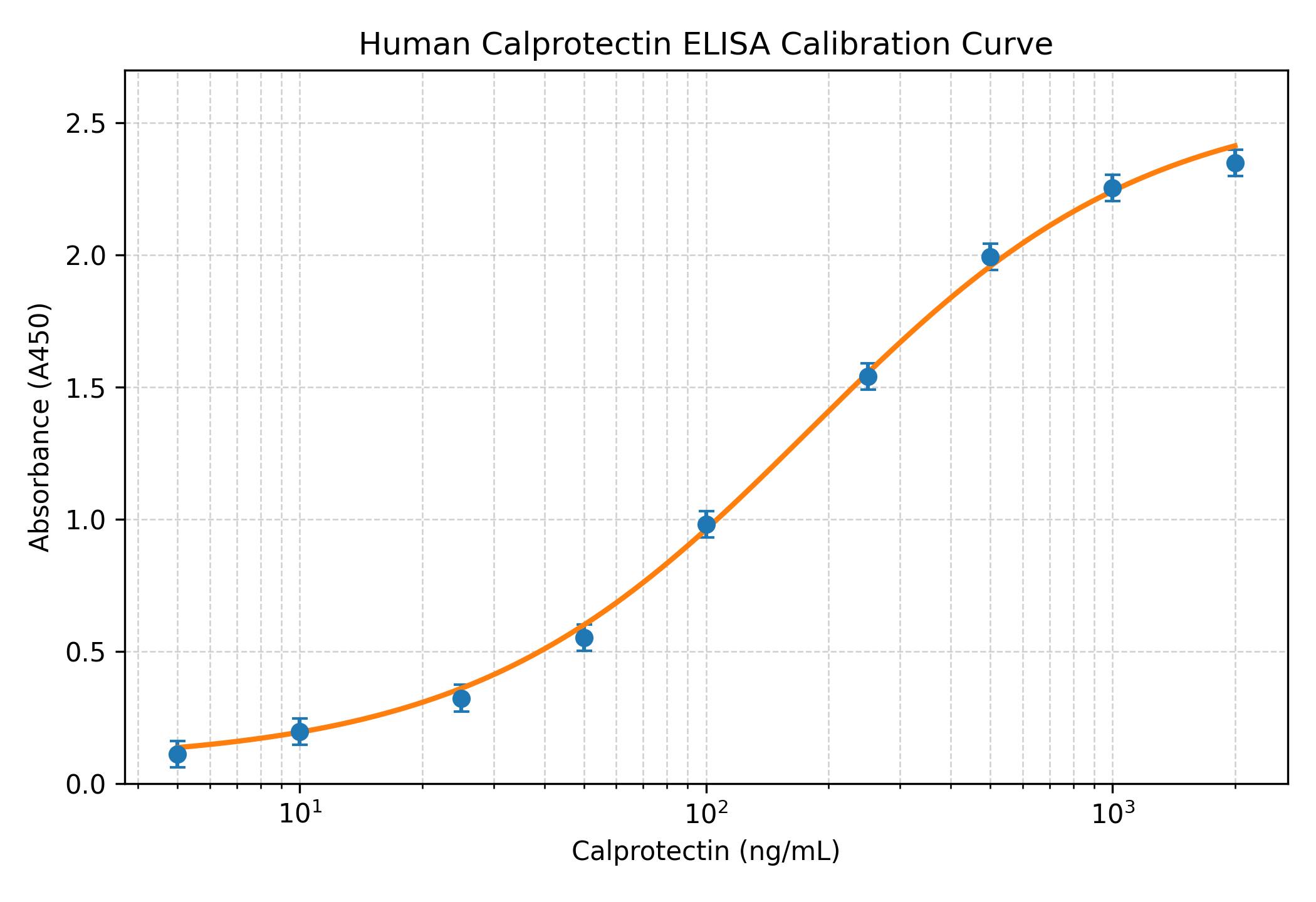
Analytical Performance
Dynamic Detection Range
• 5 – 2,000 ng/mL
Analytical Sensitivity
• Limit of Detection (LOD): ≤ 2 ng/mL
Precision
• Intra-assay CV: < 10%
• Inter-assay CV: < 12%
Selectivity & Specificity
The assay demonstrates high specificity for the calprotectin heterodimer with minimal cross-reactivity to individual S100 proteins.
Representative cross-reactivity:
• Calprotectin (S100A8/A9): 100%
• S100A8 or S100A9 alone: < 1%
• S100B, REG3α, defensins: < 1%
Kit Components
Each kit contains sufficient reagents for up to 96 determinations:
• Antibody-coated 96-well microplate
• Calprotectin standards (lyophilized, multiple concentrations)
• Biotinylated detection antibody
• Enzyme conjugate
• Assay buffer
• Wash buffer (10×)
• TMB substrate
• Stop solution
• Detailed assay protocol
Sample Collection & Handling
• Collect samples using standard laboratory procedures.
• Avoid repeated freeze–thaw cycles.
• Fecal samples should be extracted using appropriate buffers prior to analysis.
• Samples exceeding the highest standard should be diluted using assay buffer.
Storage & Stability
• Store all components at 2–8 °C.
• Do not freeze reagents unless explicitly stated.
• Unopened kits are stable until the stated expiration date.
Applications
• Gut-on-chip inflammation and barrier disruption studies
• Neutrophil activation and innate immune response analysis
• Host–microbiome interaction research
• Inflammatory bowel disease modeling
• Drug and biologic screening
• Biodevice calibration and benchmarking