Product Description
The BioDeviceLab 50 nm Endotoxin-Free Gold Nanoparticles are precision-engineered colloidal particles designed for biologically sensitive and optically demanding applications. At ~50 nm diameter, these nanoparticles exhibit pronounced localized surface plasmon resonance (LSPR) with enhanced light scattering and absorbance, enabling robust optical detection, colorimetric assay amplification, and plasmonic biosensing.
These nanoparticles are synthesized using controlled protocols followed by endotoxin-reduction and verification procedures to minimize lipopolysaccharide (LPS) contamination. The particles are stabilized using citrate-based ligands in an aqueous formulation, providing excellent colloidal stability while maintaining compatibility with biological samples, microfluidic platforms, and lab-on-chip systems.
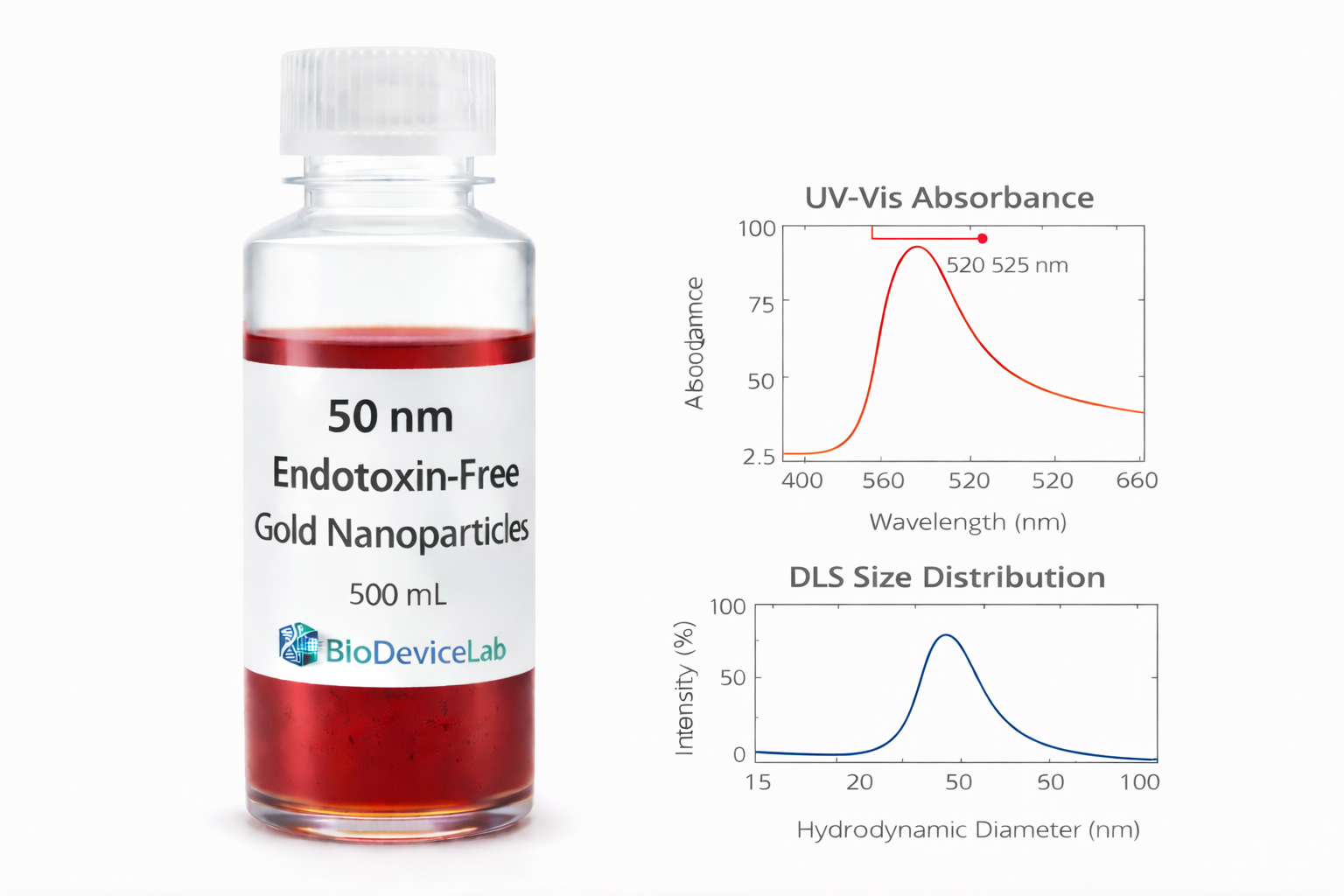
The characteristic SPR absorbance peak near 525–535 nm enables reliable UV–Vis characterization and quality control. The 50 nm size offers a strong balance between optical signal intensity and functional surface area, supporting efficient passive adsorption of proteins, antibodies, and ligands while minimizing unintended immune activation in endotoxin-sensitive systems.
Intended Use
This product is intended for research applications including:
• Endotoxin-sensitive biosensor and plasmonic device development
• Cell-based assays and immune response studies
• Cytokine signaling and inflammatory pathway analysis
• Passive conjugation of proteins, antibodies, and ligands
• Optical and colorimetric signal amplification
• Microfluidic and lab-on-chip integration
Principle of Operation
Gold nanoparticles exhibit localized surface plasmon resonance (LSPR), arising from collective oscillation of conduction electrons in response to incident light.
• The SPR peak position and intensity depend on particle size and surrounding environment.
• Biomolecule binding alters the local refractive index, modulating optical signals.
• The 50 nm size enhances scattering and absorbance compared to smaller particles.
• Endotoxin-free formulation reduces background immune activation in sensitive assays.
Calibration & Optical Characterization
• Optical density (OD) is defined at the SPR peak wavelength using a 1 cm pathlength.
• UV–Vis spectroscopy verifies the characteristic absorbance peak (~525–535 nm).
• Particle concentration and molar extinction coefficients are calculated at OD = 1.
• Dynamic Light Scattering (DLS) confirms hydrodynamic size centered near 50 nm and low dispersity.
• Endotoxin levels are assessed using standard assays (e.g., LAL) to confirm low LPS content.
Analytical & Physical Characteristics
Nominal particle diameter: ~50 nm
Peak SPR wavelength: ~525–535 nm
Particle concentration: ~2.0 × 10¹² particles/mL
Weight concentration: ~1.0 mg/mL
Molar extinction coefficient: ~3.0 × 10⁸ M⁻¹·cm⁻¹
Size dispersity: <15%
Surface area per particle: ~7.85 × 10³ nm²
Surface-to-volume ratio: ~0.24
Particle mass: ~1.02 × 10⁻¹⁵ g
Molar mass: ~6.15 × 10⁸ g/mol
Molar concentration: ~3.2 × 10⁻¹⁰ M
Supplied volume: 500 mL
Endotoxin level: Certified low endotoxin (specification available on request)
Selectivity & Compatibility
Gold nanoparticles are chemically inert and broadly compatible with biological molecules and assay platforms. The endotoxin-free preparation minimizes unintended immune activation, making these nanoparticles suitable for cell-based, immunological, and host–microenvironment studies.
Package Contents
Each unit contains:
• 500 mL of 50 nm endotoxin-free citrate-stabilized gold nanoparticle colloidal suspension
• Optical characterization documentation
• Endotoxin quality assurance report
Required Materials (Not Provided)
• UV–Vis spectrophotometer
• Dynamic Light Scattering (DLS) instrument (recommended)
• Endotoxin-free laboratory consumables
• Buffers compatible with sensitive biological workflows
Sample Handling & Use
• Gently swirl before use to ensure uniform suspension.
• Avoid vigorous shaking or sonication that may induce aggregation.
• Use endotoxin-free containers and pipette tips for sensitive assays.
• Dilute with compatible aqueous buffers as required.
Quality Control
• Each production lot is verified for SPR peak position, particle concentration, size distribution, and endotoxin level.
• Batch-to-batch consistency supports reproducibility in sensitive biological workflows.
• Optical, physical, and endotoxin metrics follow standardized QC procedures.
Storage & Stability
• Store at 4–25 °C.
• Do not freeze.
• Protect from prolonged exposure to direct light.
• When stored properly, the colloid maintains stability and optical performance throughout its shelf life.
Limitations
• For research use only.
• Not intended for diagnostic or therapeutic use.
• Performance may vary depending on buffer composition and functionalization strategy.
Applications
• Endotoxin-sensitive biosensor development
• Cell culture and immune signaling studies
• Host–microbiome and inflammatory pathway modeling
• Protein and antibody conjugate engineering
• Microfluidic and lab-on-chip systems
• Biodevice calibration and benchmarking