
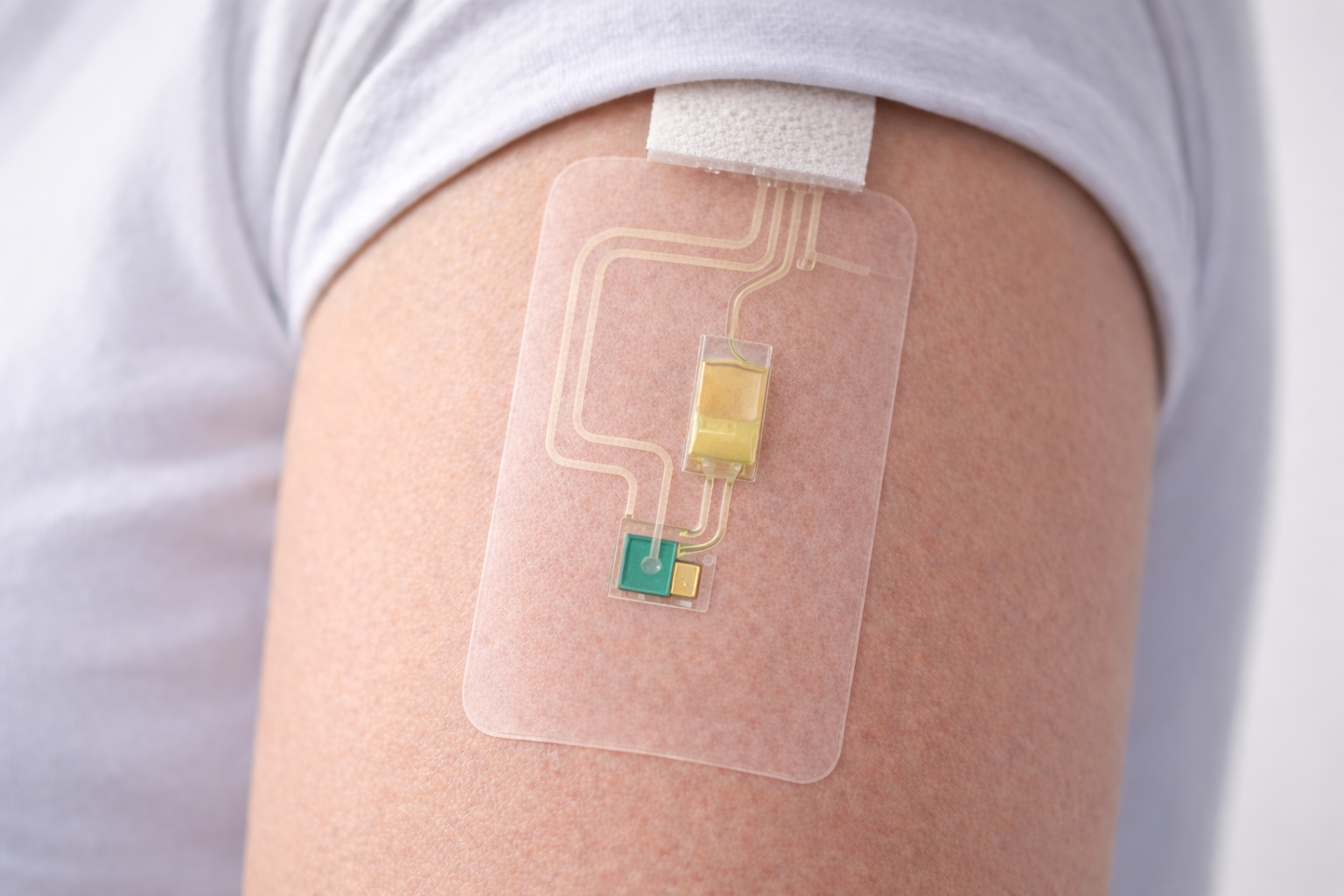
Product description
The BioDeviceLab Wearable Absorptive Microfluidic Sensing Patch is a fully self-contained, flexible platform designed for passive collection and analysis of biofluids such as sweat or interstitial fluid. An integrated absorbent pad positioned at the skin interface continuously wicks fluid into the microfluidic network, eliminating the need for external pumps, tubing, or luer connectors.
Collected biofluid is guided through low-dead-volume microchannels into a dedicated sensing chamber housing an embedded electrochemical or chemical sensor. The optically transparent, multilayer polymer structure enables real-time visualization while maintaining comfort and mechanical compliance during wear. The compact, adhesive-backed design supports stable operation under daily motion, enabling continuous or time-integrated monitoring at the point of use.
This platform is optimized for wearable diagnostics, continuous physiological monitoring, and fully untethered sensing applications.
Key features
Passive biofluid collection using an integrated absorbent pad
Self-contained operation without tubing or external pumps
Low dead-volume microfluidic routing
Integrated sensing chamber for electrochemical or chemical detection
Flexible, lightweight, skin-conformal patch design
Optically transparent for visual inspection or imaging
Stable performance under bending and motion
Designed for untethered, wearable use
Technical specifications
Sampling mechanism: absorbent pad–driven passive wicking
Biofluids supported: sweat, interstitial fluid, or other low-volume biofluids
Absorbent pad materials: hydrogel, porous polymer, or fiber-based substrates
Reservoir volume: microliter-scale, application dependent
Channel dimensions: customizable, typically 50–500 µm width
Sensor compatibility: electrochemical, enzymatic, or colorimetric sensors
Materials: biocompatible, optically transparent polymer layers
Patch format: thin, flexible, adhesive-backed multilayer structure
Readout: electrical, optical, or image-based
Wearability: stable operation under mild skin deformation
Applications
Untethered wearable biosensing and diagnostics
Continuous physiological monitoring
Non-invasive health and wellness tracking
Point-of-care and at-home testing
Integration with electrochemical sensor platforms
Research and translational wearable microfluidics


