
Product description
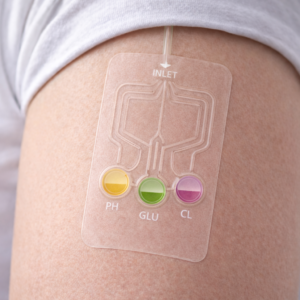
The BioDeviceLab Wearable Multiplex Electrolyte & Metabolite Microfluidic Patch is a transparent, flexible platform designed for continuous sweat collection and parallel biochemical analysis directly on the skin. Sweat is guided through an integrated microfluidic network into multiple isolated sensing chambers, each dedicated to a specific analyte such as lactate, potassium, pH, or glucose.
The patch supports colorimetric, fluorescent, or biosensor-based detection schemes, enabling real-time or time-integrated readout. Its low-profile, adhesive-backed construction maintains stable operation during movement, while optical transparency allows direct visual inspection or camera-based quantification. External tubing interfaces enable controlled calibration, flushing, or integration with external fluid handling modules when required.
This platform enables non-invasive, wearable monitoring of physiological status for health, performance, and diagnostic applications.
Key features
Passive sweat collection at the skin interface
Multiplex microfluidic routing to isolated sensing chambers
Parallel detection of electrolytes and metabolites
Optically transparent for visual or optical readout
Flexible, lightweight, skin-conformal patch design
Low dead-volume microfluidic architecture
Compatible with colorimetric, fluorescent, and biosensing chemistries
Optional tubing interface for calibration or controlled fluid delivery
Technical specifications
Analytes supported: electrolytes (K⁺, Cl⁻), metabolites (lactate, glucose), pH
Number of sensing chambers: customizable: 4
Reservoir volume: microliter-scale, application dependent
Channel dimensions: customizable, 200-300 µm width
Materials: biocompatible, optically transparent polymer layers
Patch format: thin, flexible, adhesive-backed multilayer structure
Sampling mode: passive sweat uptake
Readout: visual inspection, smartphone imaging, or optical sensing
Wearability: stable operation under motion and mild skin deformation
Applications
Wearable electrolyte and metabolite monitoring
Athletic performance and fatigue assessment
Hydration and physiological status tracking
Non-invasive health monitoring
Point-of-care and at-home diagnostics
Research and development of wearable biosensing platforms