Short Description
The BioDeviceLab Human Interleukin-33 (IL-33) ELISA Kit is a high-sensitivity sandwich immunoassay for quantitative measurement of IL-33 in serum, plasma, and cell culture supernatants. The assay enables precise assessment of epithelial stress, alarmin release, and immune–epithelial signaling in gut-on-chip and mucosal immunity models.
For Research Use Only (RUO).
Product Overview
The BioDeviceLab Human IL-33 ELISA Kit is a high-performance enzyme-linked immunosorbent assay developed to quantify IL-33, an epithelial-derived alarmin released upon cellular stress, damage, or microbial challenge. IL-33 signals through the ST2 receptor to activate innate and adaptive immune cells, including ILC2s, Th2 cells, mast cells, and macrophages, shaping downstream inflammatory and tissue-repair programs.
IL-33 is a critical marker of epithelial injury, barrier disruption, and immune activation at mucosal surfaces. It plays a central role in orchestrating repair responses, modulating inflammation, and influencing host–microbiome interactions. In gut-on-chip platforms, IL-33 serves as a sensitive readout of epithelial damage, mechanical or chemical stress, and immune-triggered tissue remodeling. This assay combines high analytical sensitivity, strong specificity, and reproducible performance suitable for mechanistic studies and biodevice validation workflows.
Intended Use
This kit is intended for the quantitative determination of IL-33 in:
• Serum
• Plasma
• Cell culture supernatants
Applications include gut-on-chip epithelial stress modeling, alarmin signaling studies, host–microbiome interaction research, inflammation and injury models, drug and biologic screening, and biodevice calibration and benchmarking.
Assay Principle
This assay employs a sandwich ELISA format:
• IL-33 present in the sample binds to capture antibodies immobilized on a 96-well microplate.
• A biotinylated detection antibody specific to IL-33 binds to the captured cytokine.
• An enzyme conjugate is added, followed by chromogenic substrate (TMB).
• The enzymatic reaction generates a colorimetric signal measured at 450 nm.
• Absorbance is directly proportional to IL-33 concentration.
Calibration Curve
• Generated using recombinant human IL-33 standards.
• Mean absorbance values plotted versus concentration on a semi-logarithmic scale.
• Four-parameter logistic (4PL) regression recommended.
• Sample concentrations interpolated from the standard curve.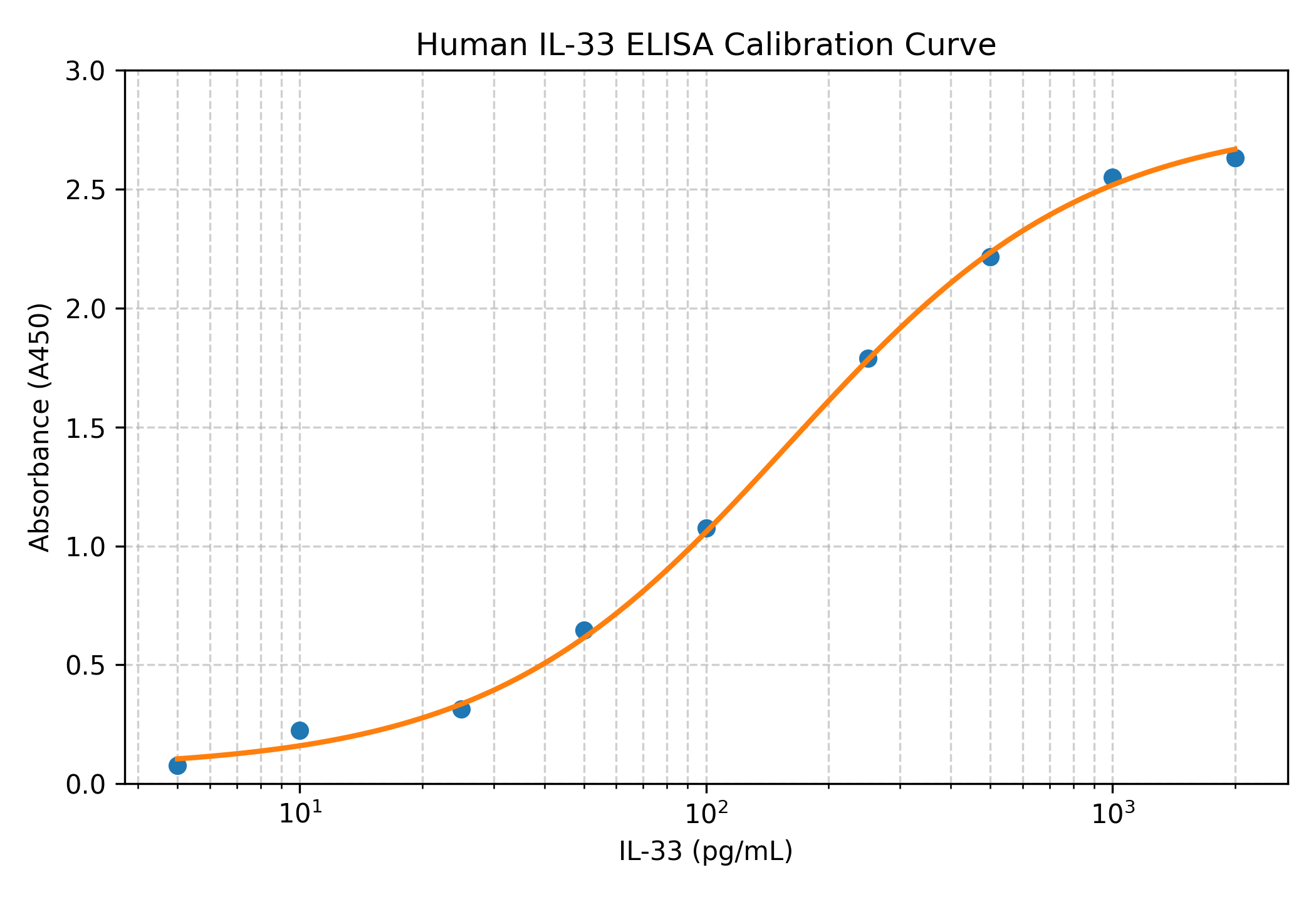
Analytical Performance
Dynamic Detection Range
• 10 – 2,000 pg/mL
Analytical Sensitivity
• Limit of Detection (LOD): ≤ 5 pg/mL
Precision
• Intra-assay CV: < 5%
• Inter-assay CV: < 10%
Selectivity & Specificity
High specificity for human IL-33 with minimal cross-reactivity to IL-1α, IL-1β, IL-18, and HMGB1 (< 1%).
Kit Components
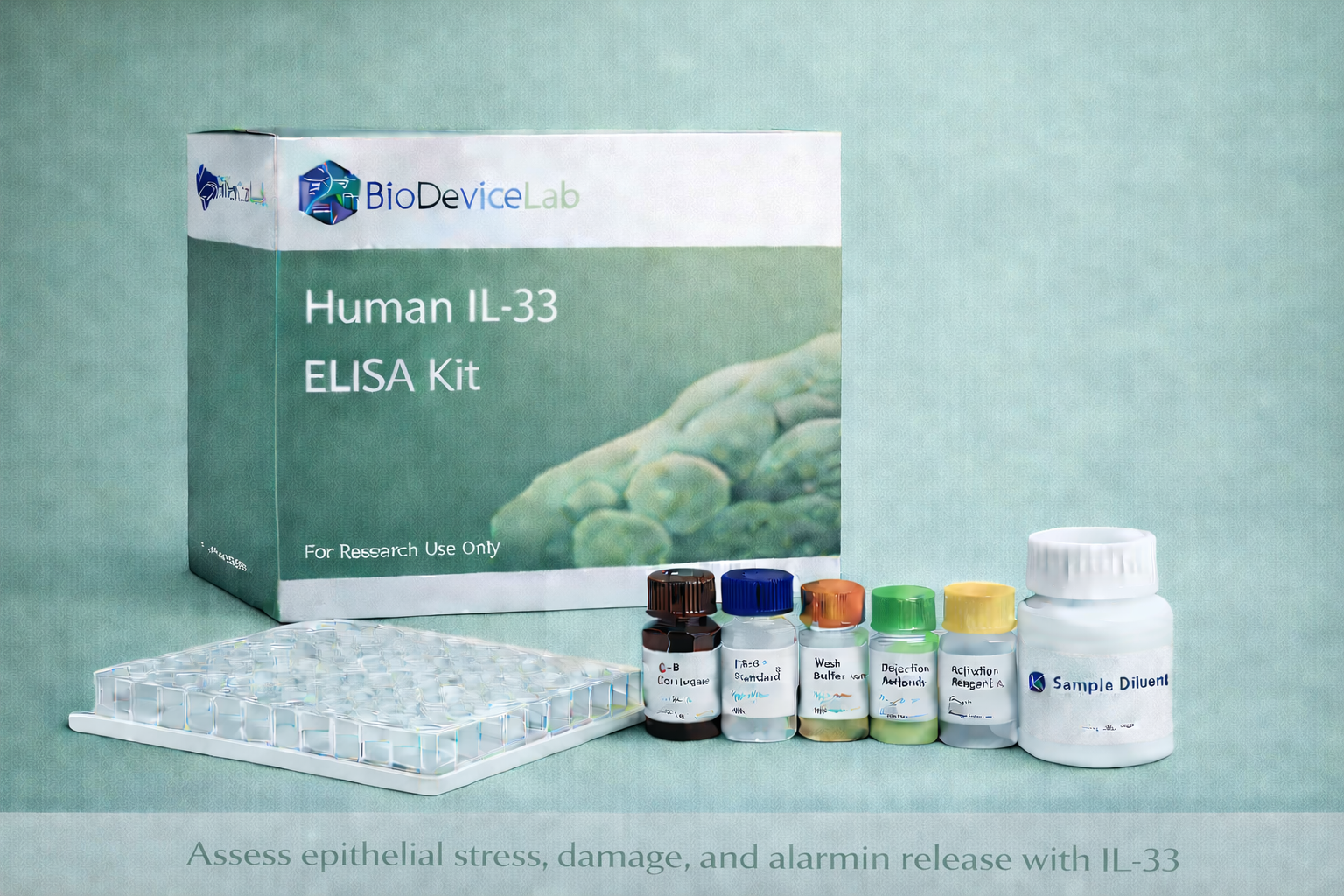
• Antibody-coated 96-well microplate
• IL-33 standards (lyophilized)
• Biotinylated detection antibody
• Enzyme conjugate
• Assay buffer
• Wash buffer (10×)
• TMB substrate
• Stop solution
• Detailed protocol
Applications
• Epithelial stress and alarmin signaling studies
• Gut-on-chip barrier injury and repair modeling
• Host–microbiome immune interaction research
• Inflammation and tissue remodeling models
• Drug and biologic screening
• Biodevice calibration and benchmarking