Product Description
The BioDeviceLab 15 nm Gold Nanoparticles are precision-synthesized colloidal nanoparticles that combine narrow size distributions with strong localized surface plasmon resonance (LSPR) properties. At ~15 nm diameter, these particles provide enhanced optical absorption and scattering, making them highly effective for UV–Vis–based characterization and colorimetric assay design.
These nanoparticles are stabilized with citrate/tannic acid ligands in an aqueous formulation compatible with biological samples, microfluidic systems, and lab-on-chip platforms. The 15 nm size offers a balance between optical cross section and surface area, supporting efficient biomolecule adsorption and passive conjugation to proteins, antibodies, and other ligands without additional surface modification steps.
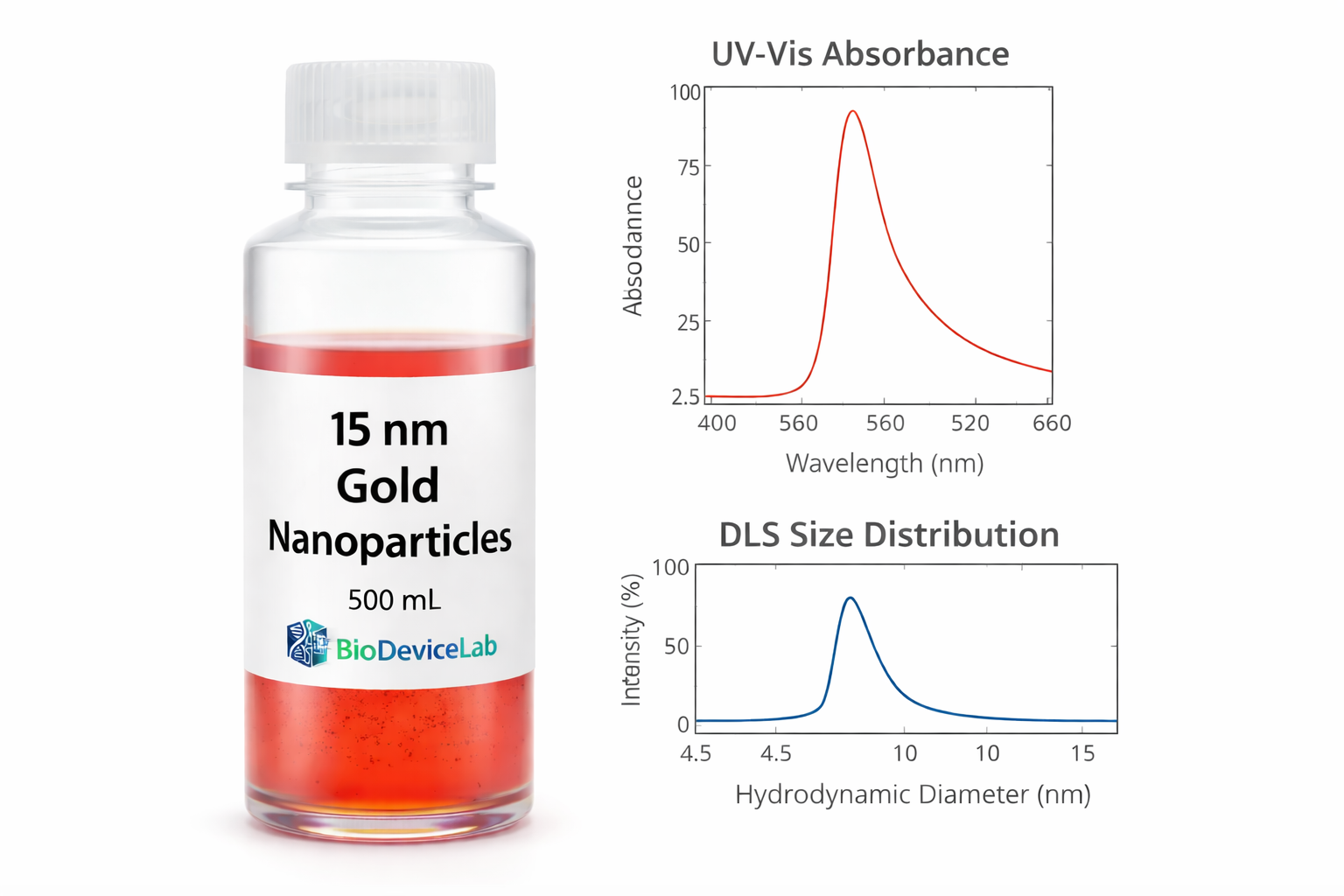
The characteristic SPR peak near 520–525 nm enables reliable optical detection, while the bulk 500 mL volume supports scalable assay development, conjugate preparation, and repeated experimental use. The reproducible optical and physical properties make these nanoparticles suitable for analytical workflows, biosensor calibration, and signal enhancement.
Intended Use
This product is intended for research applications including:
• Biosensor and plasmonic assay development
• Passive conjugation to proteins, antibodies, and ligands
• Optical signal amplification and colorimetric assays
• Microfluidic and lab-on-chip integration
• Biodevice calibration and benchmarking
• Imaging contrast and analytical characterization
Principle of Operation
Gold nanoparticles exhibit localized surface plasmon resonance, where conduction electrons on the particle surface oscillate collectively in response to incident electromagnetic radiation.
• The SPR peak’s intensity and position depend on particle size, shape, and surrounding medium.
• Changes in local refractive index (e.g., biomolecule binding) shift the SPR signal, enabling optical sensing.
• High surface area supports effective biomass adsorption and functionalization for assay design.
• These properties make 15 nm gold nanoparticles versatile optical reporters in biosensing platforms.
Calibration & Optical Characterization
• Optical density (OD) is defined at the SPR peak using a 1 cm pathlength.
• UV–Vis spectroscopy is used to verify the characteristic absorbance maximum (~520–525 nm).
• Particle concentration and molar extinction coefficients are derived based on OD = 1.
• Dynamic Light Scattering (DLS) verifies hydrodynamic size and dispersity.
• Optical and size metrics should be confirmed for each experimental workflow.
Analytical & Physical Characteristics
Nominal particle diameter: ~15 nm
Peak SPR wavelength: ~520–525 nm
Particle concentration: ~1.21 × 10¹³ particles/mL
Weight concentration: ~2.08 × 10⁻¹ mg/mL
Molar extinction coefficient: ~3.80 × 10⁷ M⁻¹·cm⁻¹
Size dispersity: <15%
Surface area per particle: ~7.07 × 10² nm²
Surface-to-volume ratio: ~0.4
Particle mass: ~1.14 × 10⁻¹⁶ g
Molar mass: ~1.71 × 10⁷ g/mol
Molar concentration: ~7.07 × 10⁻⁹ M
Supplied volume: 500 mL
Selectivity & Compatibility
Gold nanoparticles are chemically inert and broadly compatible with biological molecules and assay platforms. They exhibit minimal nonspecific interactions and can be integrated with proteins, nucleic acids, polymers, and electrochemical interfaces without interfering with biological recognition events.
Package Contents
Each unit contains:
• 500 mL of 15 nm citrate-stabilized gold nanoparticle colloidal suspension
• Optical characterization and quality control documentation
Required Materials (Not Provided)
• UV–Vis spectrophotometer
• Dynamic Light Scattering (DLS) instrument (recommended)
• Standard pipettes and laboratory consumables
• Buffers compatible with downstream functionalization
Sample Handling & Use
• Swirl gently before use to ensure uniform suspension.
• Avoid vigorous shaking or sonication that may induce aggregation.
• Dilute with compatible aqueous buffers for downstream applications.
• Minimize repeated contamination of the stock solution.
Quality Control
• Each production lot is verified for SPR peak position, particle concentration, and size distribution.
• Batch consistency supports reproducibility for biodevice development workflows.
• Optical density and size metrics follow standardized QC practices.
Storage & Stability
• Store at 4–25 °C.
• Do not freeze.
• Protect from prolonged direct light exposure.
• Proper storage maintains colloidal stability and performance over the product’s shelf life.
Limitations
• For research use only.
• Not intended for diagnostic or therapeutic use.
• Performance may vary with buffer conditions and functionalization strategies.
Applications
• Biosensor and plasmonic device development
• Optical assay design and enhancement
• Protein and antibody conjugate preparation
• Microfluidic and lab-on-chip systems
• Biodevice calibration and benchmarking
• Imaging contrast and analytical probing