
Product Description
The BioDeviceLab 50 nm Water-Soluble Quantum Dots are advanced fluorescent nanomaterials designed for applications demanding maximum brightness and optical contrast. With a larger nanocrystal size, these quantum dots provide increased absorption cross-section and higher photon output compared to smaller quantum dots, making them particularly suitable for macroscopic imaging, high-throughput screening, and optical readout in biodevices.
These quantum dots are surface-engineered with hydrophilic, water-soluble coatings that ensure excellent colloidal stability in aqueous buffers, biological media, and microfluidic systems. Their robust optical performance and resistance to photobleaching support prolonged imaging sessions and repeated excitation cycles without significant signal degradation.
The 300 mL bulk volume supports scalable workflows, including extended imaging experiments, multiplex assay development, and system-level validation of fluorescence-based biosensors and lab-on-chip devices.
Intended Use
This product is intended for research applications including:
• High-intensity fluorescence imaging
• Multiplex biosensing and optical assays
• High-throughput screening platforms
• Flow cytometry and particle labeling
• Microfluidic and lab-on-chip integration
• Optical calibration and biodevice validation
Principle of Operation
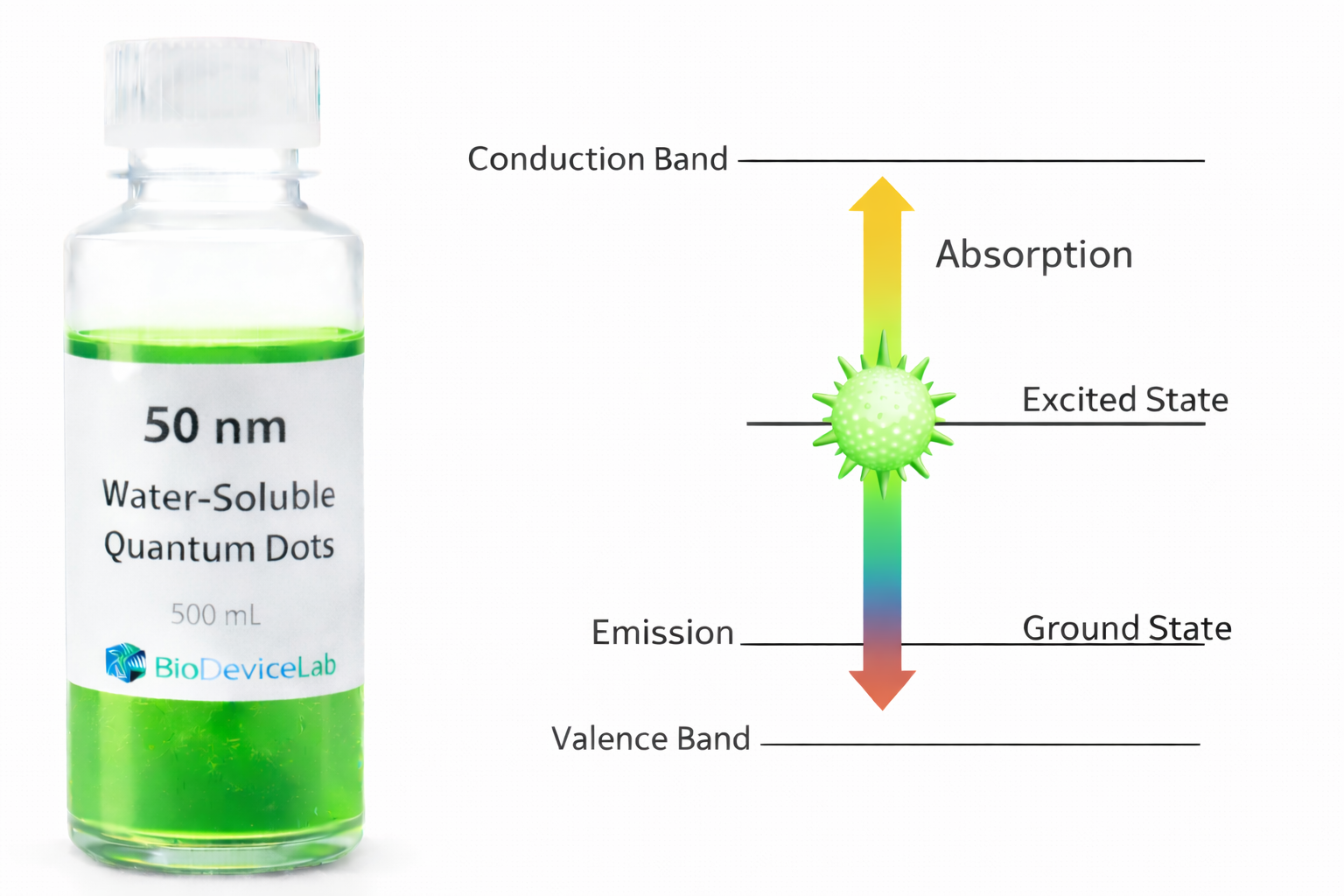
Quantum dots operate based on quantum confinement–driven fluorescence:
• Optical excitation generates electron–hole pairs within the semiconductor nanocrystal.
• Radiative recombination produces bright, size-dependent fluorescence emission.
• Larger quantum dots exhibit increased brightness and absorption efficiency.
• Surface passivation ensures water solubility and compatibility with biological systems.
Optical & Physical Characteristics
Core diameter: ~50 nm
Emission range: Visible spectrum (composition-dependent)
Quantum yield: Very high
Photostability: Excellent
Surface chemistry: Water-soluble, hydrophilic coating
Colloidal stability: High in aqueous buffers
Supplied volume: 500 mL
Selectivity & Compatibility
The narrow emission bandwidth of the 50 nm quantum dots supports multiplexed detection with minimal spectral overlap. Their surface chemistry is compatible with proteins, antibodies, and nucleic acids, enabling conjugation for targeted imaging and sensing applications.
Package Contents
Each unit contains:
• 500 mL of 50 nm water-soluble quantum dot colloidal suspension
• Optical characterization and fluorescence profile documentation
Required Materials (Not Provided)
• Fluorescence microscope or plate reader
• Low-autofluorescence labware
• Standard laboratory pipettes and consumables
• Compatible aqueous buffers
Sample Handling & Use
• Gently invert before use to ensure uniform dispersion.
• Protect from prolonged exposure to high-intensity light.
• Dilute using compatible aqueous buffers as needed.
• Avoid freezing unless explicitly validated.
Quality Control
• Each production lot is evaluated for emission peak, brightness, and colloidal stability.
• Batch-to-batch consistency supports reproducible optical measurements and device validation.
Storage & Stability
• Store at 4–25 °C, protected from light.
• Do not freeze unless otherwise specified.
• Stable under recommended storage conditions for the stated shelf life.
Limitations
• For research use only.
• Not intended for diagnostic or therapeutic applications.
• Optical properties may vary depending on surface chemistry and experimental environment.
Applications
• High-brightness fluorescence imaging
• Multiplex optical biosensors
• High-throughput screening assays
• Flow cytometry and particle tracking
• Microfluidic fluorescence systems
• Biodevice calibration and benchmarking


