Product Description
The BioDeviceLab 20 nm Silica Nanoparticles are precision-engineered inorganic nanospheres developed for advanced biological, analytical, and biodevice research. With a nominal particle diameter of ~20 nm, these nanoparticles provide a balanced surface-to-volume ratio that supports efficient biomolecule immobilization while maintaining enhanced colloidal stability compared to smaller silica nanomaterials.
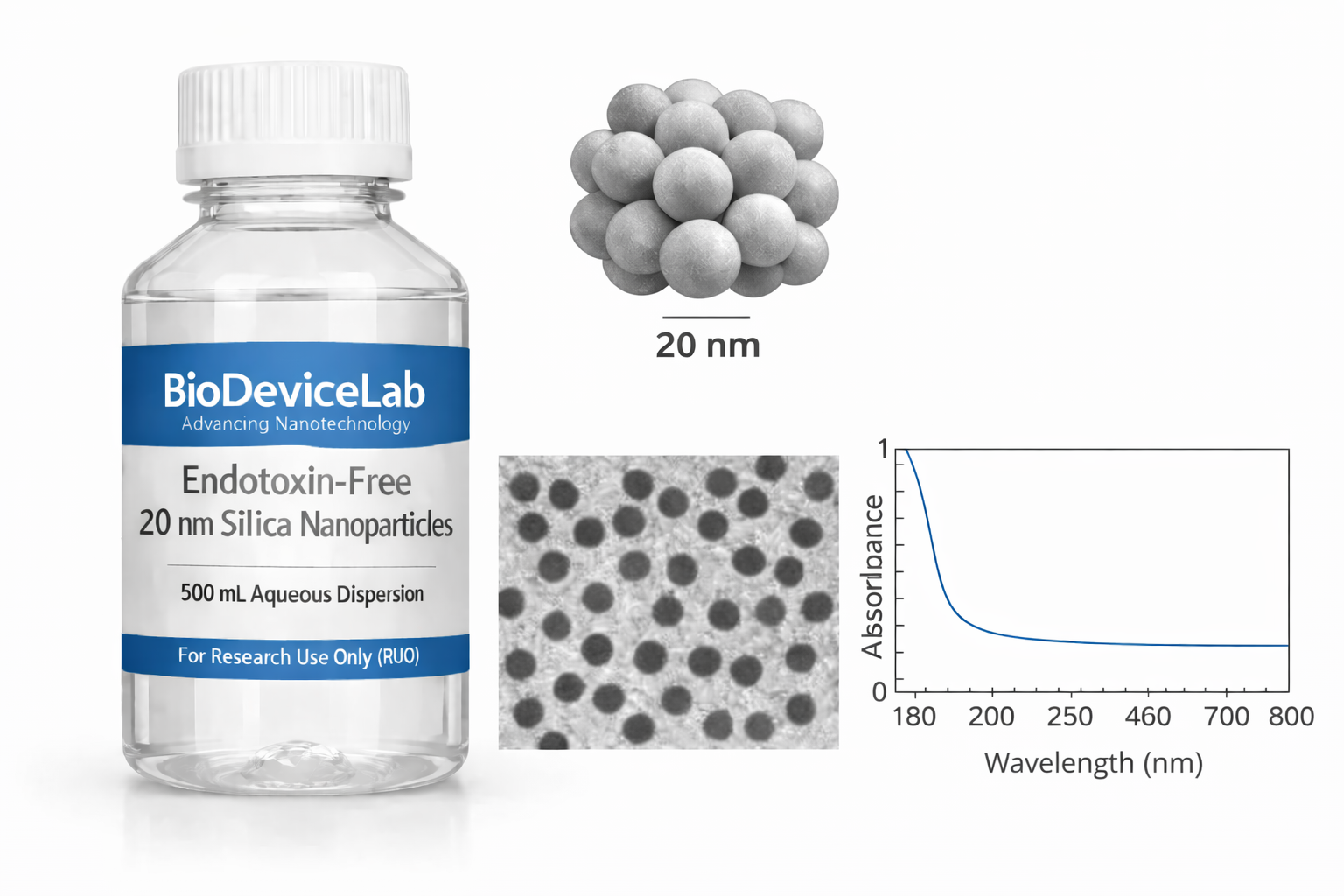
Unlike plasmonic or fluorescent nanoparticles, silica nanoparticles are optically transparent across the visible spectrum and exhibit characteristic UV absorbance below ~230 nm. This optical behavior minimizes background interference in optical, electrochemical, and hybrid sensing platforms, making them ideal as inert scaffolds in biosensors, microfluidic systems, and lab-on-chip devices.
Manufactured under controlled synthesis conditions, these nanoparticles exhibit narrow size distribution, low aggregation, and reproducible physicochemical properties. Supplied in a 500 mL bulk aqueous dispersion, this product supports large-scale surface chemistry optimization, assay development, and translational biodevice validation workflows.
Intended Use
This product is intended for research applications including:
• Biosensor surface engineering and signal amplification
• Biomolecule immobilization and linker chemistry development
• Drug delivery and nanocarrier research
• Microfluidic and lab-on-chip material integration
• Cell interaction and uptake studies
• Reference nanomaterial for method development and benchmarking
Principle of Operation
Silica nanoparticles function as chemically inert, high-surface-area platforms for biological and chemical functionalization. The amorphous SiO₂ surface presents abundant silanol (–OH) groups that enable covalent attachment of proteins, antibodies, aptamers, polymers, and other ligands. Optical transparency in the visible range prevents spectral interference, while the 20 nm size provides improved mechanical and colloidal stability for extended experimental workflows.
Characterization & Quality Control
Particle size and morphology are verified by transmission electron microscopy (TEM). Hydrodynamic diameter and size dispersity are confirmed by dynamic light scattering (DLS), and zeta potential analysis is used to assess colloidal stability. Standardized synthesis and quality control protocols ensure batch-to-batch reproducibility.
Analytical & Physical Characteristics
Nominal particle diameter: ~20 nm
Material: Amorphous silica (SiO₂)
Morphology: Spherical
Size dispersity: <15%
Surface chemistry: Native silica (–OH rich)
Optical properties: UV absorbance below ~230 nm; optically transparent in visible range
Dispersion medium: Aqueous
Supplied volume: 500 mL
Custom surface functionalization available upon request
Selectivity & Compatibility
Silica nanoparticles are chemically inert and broadly compatible with biological molecules, buffers, and common microfluidic materials. Their non-plasmonic, non-conductive nature minimizes assay interference, supporting use in optical, electrochemical, and biochemical platforms.
Package Contents
Each unit contains:
• 500 mL of 20 nm silica nanoparticle aqueous dispersion
• Particle characterization and quality control documentation
Sample Handling & Use
Gently swirl before use to ensure uniform suspension. Avoid harsh agitation unless required for dispersion. Dilute with compatible buffers and handle using clean, contamination-free consumables.
Storage & Stability
Store at 4–25 °C. Do not freeze. Protect from prolonged contamination or evaporation. Stable under recommended storage conditions.
Limitations
For research use only. Not intended for diagnostic or therapeutic use. Performance may vary depending on surface modification strategy and experimental conditions.
Applications
• Biosensor and biodevice surface modification
• Microfluidic and lab-on-chip systems
• Nanomaterial–cell interaction studies
• Drug delivery and nanocarrier development
• Biodevice calibration and benchmarking