
Product Description
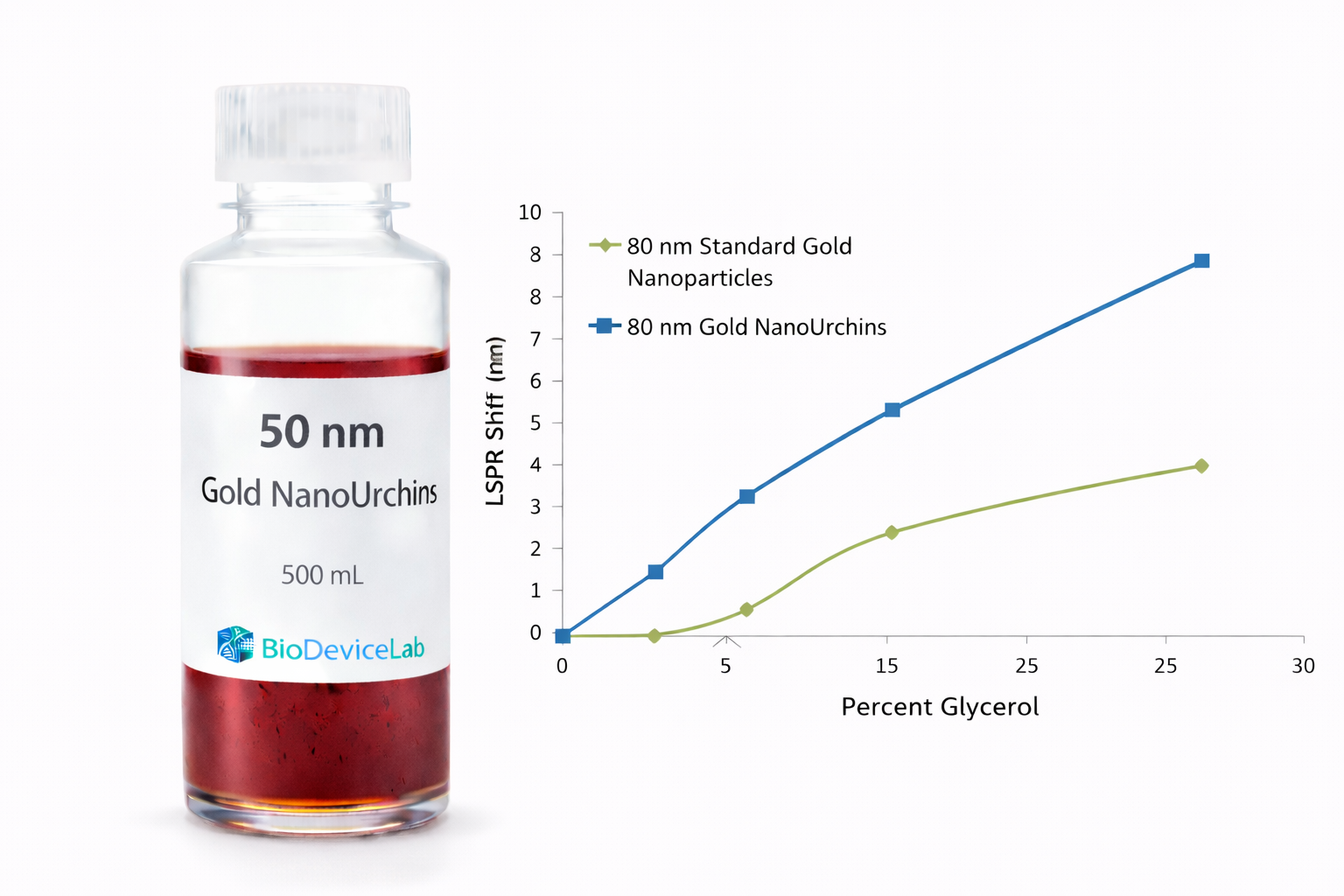
The BioDeviceLab 50 nm Gold NanoUrchins are precision-synthesized branched gold nanostructures with high surface roughness and multiple plasmonic hot spots. The increased effective surface area and anisotropic morphology enable enhanced light absorption, scattering, and localized field amplification compared to spherical particles — making them powerful transducers in plasmonic biosensing, SERS, and optical assay formats.
These urchin-shaped nanoparticles are stabilized in an aqueous colloidal suspension, providing excellent colloidal stability and compatibility with biological samples, microfluidic devices, and lab-on-chip platforms. The characteristic optical response of gold nanourchins includes broad plasmon resonance features in the visible range, supporting robust optical and colorimetric detection. The 500 mL bulk format facilitates scalable assay development, conjugate preparation, and iterative experimental use across research and translational workflows.
Intended Use
This product is intended for research applications including:
• Plasmon-enhanced biosensor development
• Surface-enhanced Raman spectroscopy (SERS)
• Optical and colorimetric assay design
• Passive conjugation of proteins, antibodies, and ligands
• Microfluidic and lab-on-chip integration
• Biodevice calibration and benchmarking
Principle of Operation
Gold NanoUrchins exhibit localized surface plasmon resonance (LSPR) and plasmonic hot spots due to their branched morphology.
• The multiple tips and facets support intense electromagnetic field enhancements.
• Light absorption and scattering are enhanced across a broader visible range than spherical particles.
• Biomolecule binding and environmental changes modulate the optical response for sensitive detection.
• High surface area increases effective binding capacity for analytes and probes.
Optical & Physical Characteristics
Nominal structure: Gold NanoUrchin
Effective diameter: ~50 nm (core and tip ensemble)
Plasmonic response: Broad visible resonance (~520–600 nm, morphology dependent)
Particle concentration: ~1.5 × 10¹² structures/mL
Weight concentration: ~1.0 mg/mL
Size dispersity: <20% effective diameter distribution
Surface area: Enhanced relative to spheres
Surface functionalization: Amenable to passive adsorption and covalent coupling
Supplied volume: 500 mL
Selectivity & Compatibility
Gold NanoUrchins are chemically inert and compatible with multiple biological materials, including proteins, nucleic acids, and polymers. Their enhanced surface area supports efficient probe immobilization with minimal impact on biological recognition.
Package Contents
Each unit contains:
• 500 mL of 50 nm gold NanoUrchin colloidal suspension
• Optical characterization and quality control documentation
Required Materials (Not Provided)
• UV–Vis spectrophotometer
• Optional Raman spectrometer (for SERS workflows)
• Standard laboratory glassware and pipettes
• Buffers compatible with downstream functionalization
Sample Handling & Use
• Gently swirl before use to ensure uniform suspension.
• Avoid vigorous shaking or sonication that may disrupt morphology.
• Dilute using compatible aqueous buffers if required.
• Minimize repeated contamination of the stock solution.
Quality Control
• Each lot is verified for plasmonic response and morphological consistency.
• Batch consistency supports reproducibility in biosensor and assay development workflows.
Storage & Stability
• Store at 4–25 °C.
• Do not freeze.
• Protect from prolonged exposure to light.
• Proper storage maintains colloidal stability and plasmonic performance.
Limitations
• For research use only.
• Not intended for diagnostic or therapeutic use.
• Performance may vary with buffer conditions and functionalization strategy.
Applications
• Plasmonic biosensing
• SERS and enhanced optical assays
• Protein and antibody conjugate engineering
• Microfluidic and lab-on-chip systems
• Biodevice calibration and benchmarking


