Product Description
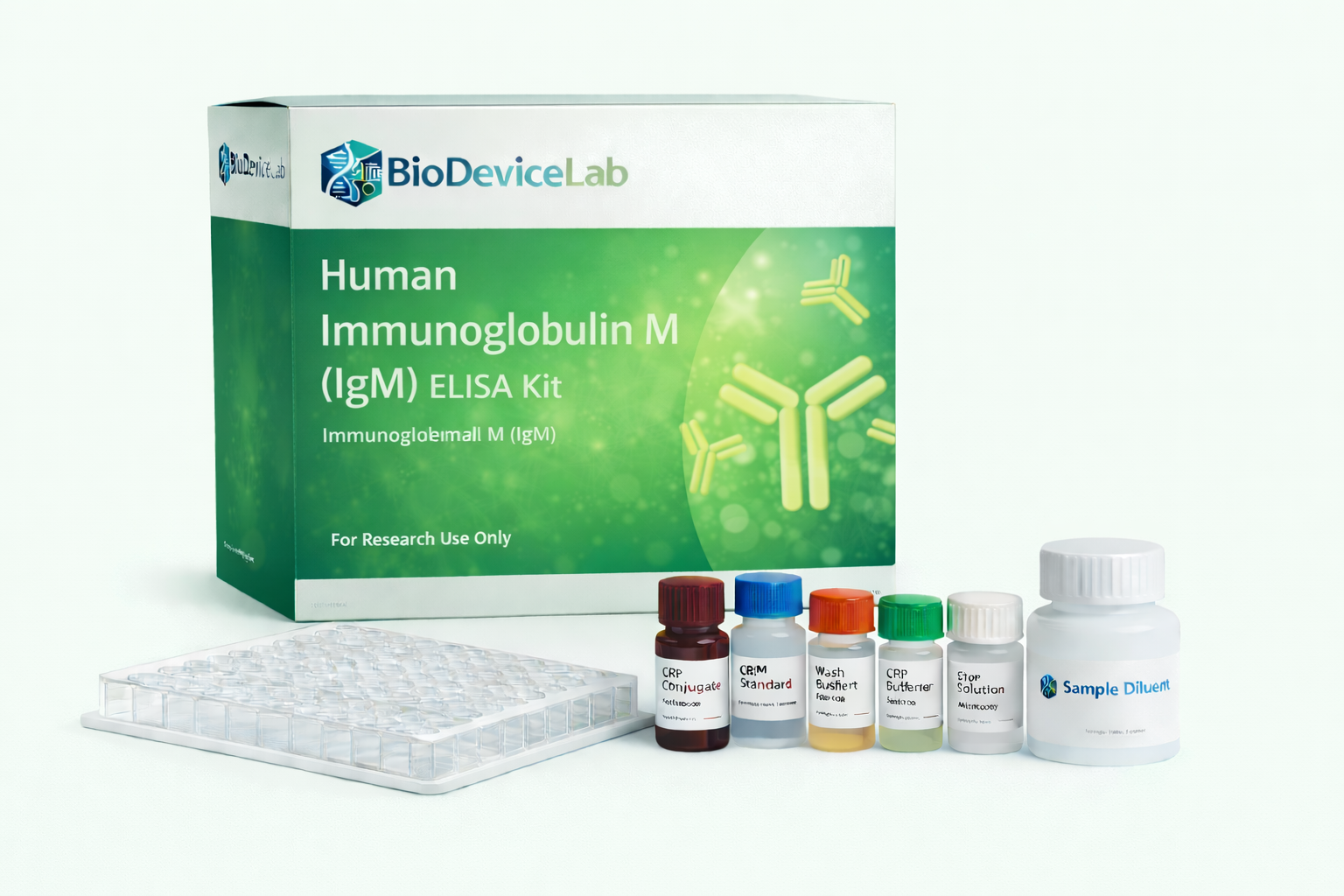
The BioDeviceLab Human Immunoglobulin M (IgM) ELISA Kit is a high-performance enzyme-linked immunosorbent assay developed for the quantitative determination of total human IgM in biological samples. IgM is the first antibody isotype produced during the initial stages of an immune response and plays a central role in early pathogen recognition, complement activation, and humoral immunity.
Measurement of IgM levels is widely used in immunology and infectious disease research to assess acute immune responses, primary infections, and early seroconversion. This assay combines high analytical sensitivity, excellent specificity, and robust reproducibility, making it suitable for routine laboratory analysis as well as advanced biodevice validation and assay integration workflows.
Intended Use
This kit is intended for the quantitative determination of human IgM in:
• Serum
• Plasma
• Cell culture supernatants
Applications include immunology research, infectious disease studies, vaccine response evaluation, serological assay development, organ-on-chip immune models, and biodevice calibration and benchmarking.
Assay Principle
This assay employs a sandwich ELISA format:
• Human IgM present in the sample binds to capture antibodies immobilized on a 96-well microplate.
• A biotinylated detection antibody specific to human IgM binds to the captured immunoglobulin.
• An enzyme conjugate is added, followed by chromogenic substrate (TMB).
• The enzymatic reaction generates a colorimetric signal measured at 520 nm.
• Absorbance is directly proportional to the IgM concentration in the sample.
Calibration Curve
• A calibration curve is generated using human IgM standards with known concentrations.
• Mean absorbance values are plotted against IgM concentration on a semi-logarithmic scale.
• A four-parameter logistic (4PL) regression model is recommended for curve fitting.
• Sample concentrations are calculated by interpolation from the standard curve.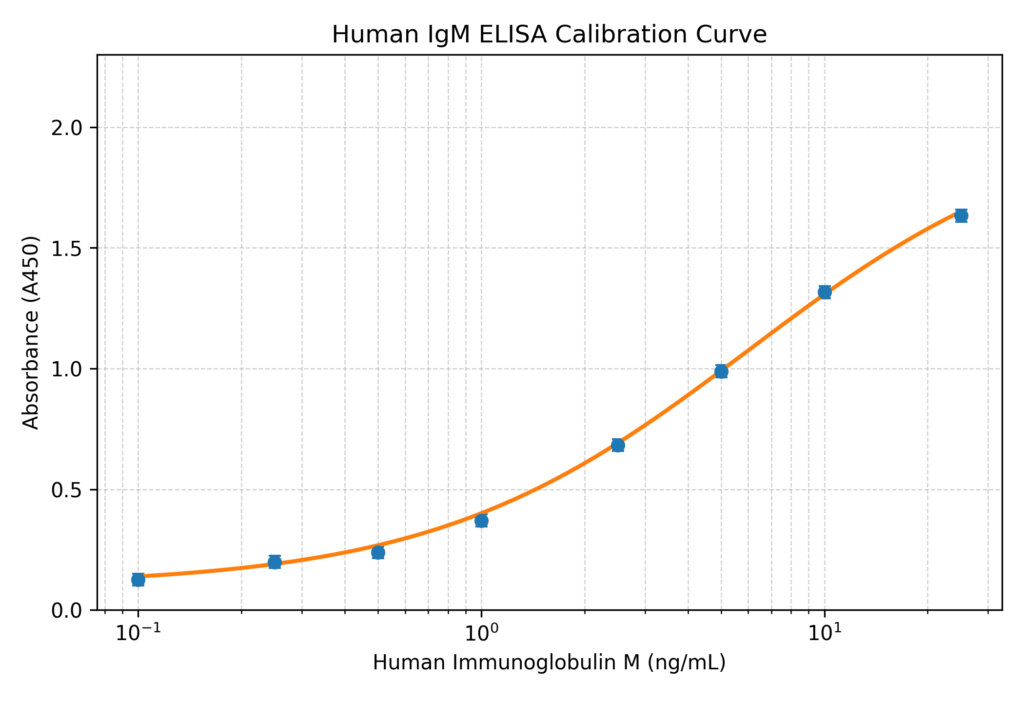
Analytical Performance
Dynamic detection range: 0.1 – 30 µg/mL
Limit of detection (LOD): ≤ 0.03 µg/mL
Intra-assay CV: < 10%
Inter-assay CV: < 10%
(Performance aligned with commercial human IgM ELISA kits used in immunology and serology research.)
Selectivity & Specificity
The assay demonstrates high specificity for human IgM with minimal cross-reactivity. Representative specificity profile:
• Human IgM: 99%
• Human IgG, IgA, IgE: < 1%
• Non-human immunoglobulins: minimal cross-reactivity
This specificity ensures accurate quantification of IgM independent of other antibody isotypes.
Kit Components
Each kit contains sufficient reagents for up to 96 determinations:
• Antibody-coated 96-well microplate
• Human IgM standards
• Biotinylated detection antibody
• Enzyme conjugate
• Assay buffer
• Wash buffer (10×)
• TMB substrate
• Stop solution
• Detailed assay protocol
Required Materials (Not Provided)
• Microplate reader capable of measuring absorbance at 450 nm
• Adjustable micropipettes and disposable tips
• Plate washer or manual washing equipment
• Plate shaker (recommended)
• Deionized or distilled water
Sample Collection & Handling
• Collect samples using standard laboratory procedures.
• Avoid repeated freeze–thaw cycles.
• Samples exceeding the highest standard should be diluted using assay buffer.
• Hemolyzed or lipemic samples may affect assay accuracy.
Quality Control
• Standards and controls should be included in each assay run.
• Duplicate measurements are recommended.
• Acceptance criteria should be established according to experimental requirements.
BioDeviceLab applies quality-controlled reagent preparation and batch-to-batch consistency practices to support reproducibility and scalability for biodevice development.
Storage & Stability
• Store all components at 2–8 °C.
• Do not freeze reagents unless explicitly stated.
• Unopened kits are stable until the stated expiration date.
• Opened reagents should be handled according to protocol recommendations.
Limitations
• For research use only.
• Not intended for diagnostic or therapeutic procedures.
• Results should be interpreted within the context of experimental design and immune status.
Applications
• Acute infection and seroconversion studies
• Immunology and humoral immune response research
• Vaccine response evaluation
• immune-on-chip models
• Biodevice calibration and benchmarking