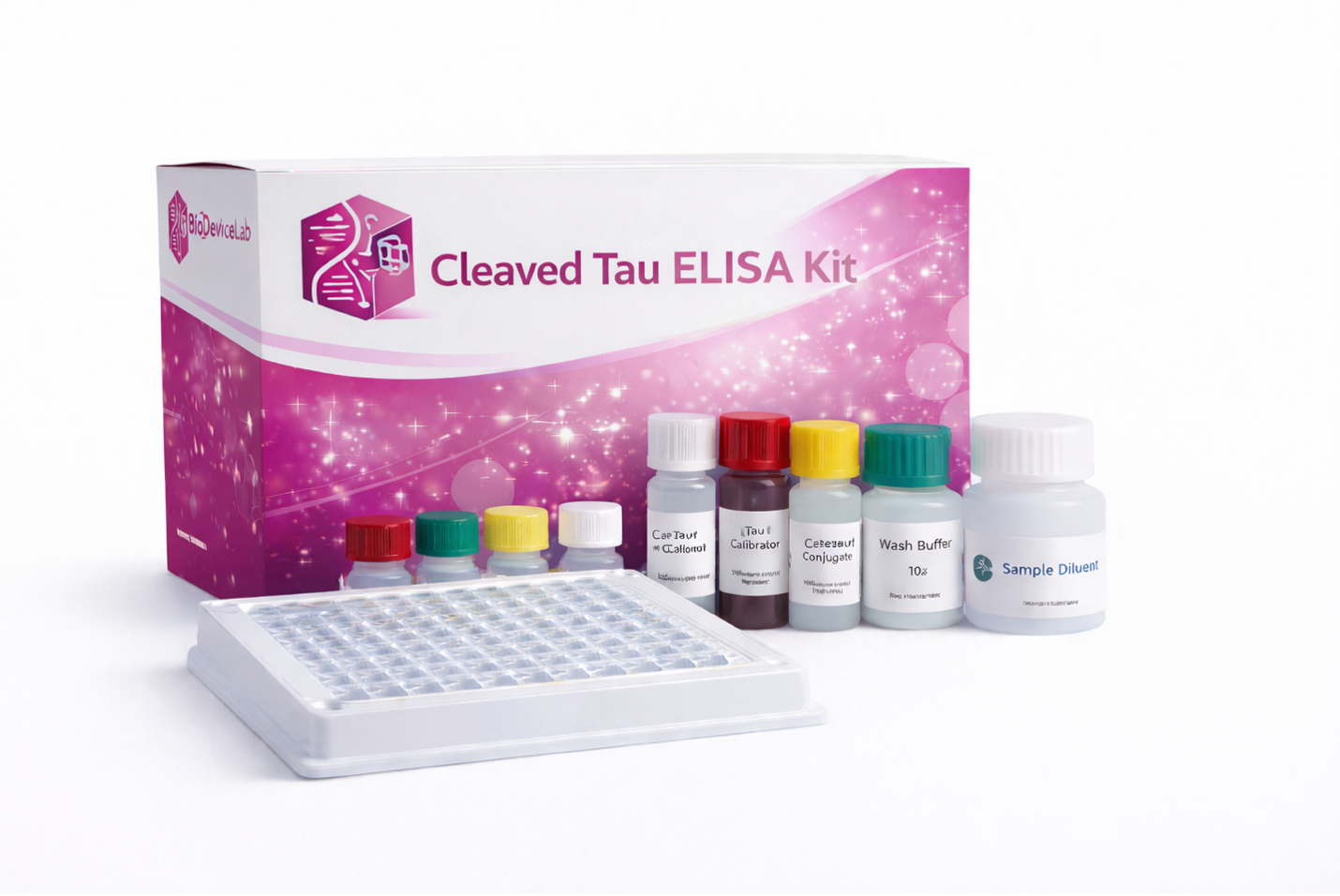
The BioDeviceLab Cleaved Tau ELISA Kit is a high-performance sandwich enzyme-linked immunosorbent assay developed for the quantitative determination of caspase-cleaved Tau, a pathology-relevant form of Tau generated during neuronal apoptosis and injury. Unlike total Tau measurements, cleaved Tau provides increased specificity for cell-death–associated Tau processing and is frequently used in studies of neurodegeneration, traumatic brain injury, ischemia, and neurotoxicology. The assay combines high sensitivity, robust reproducibility, and a wide dynamic range, making it suitable for routine laboratory analysis and advanced biodevice development workflows.
Intended Use
This kit is intended for the quantitative determination of cleaved Tau in:
• Serum
• Plasma
• Cerebrospinal fluid (CSF)
• Cell culture supernatants
Applications include apoptosis and neurotoxicity assays, neurodegeneration and Alzheimer’s disease research, traumatic brain injury and stroke research, organ-on-chip and neuronal tissue models, and biodevice validation and calibration.
Assay Principle
This assay employs a sandwich ELISA format specific to cleaved Tau:
• Cleaved Tau present in the sample binds to capture antibodies immobilized on a 96-well microplate.
• A detection antibody recognizes a neo-epitope exposed after Tau cleavage, enabling selectivity for cleaved Tau over intact Tau.
• Enzyme conjugate is added, followed by a chromogenic substrate (TMB).
• The enzymatic reaction generates a color signal measured at 450 nm.
• Absorbance is directly proportional to cleaved Tau concentration in the sample.
Calibration Curve
• A calibration curve is generated using cleaved Tau standards with known concentrations.
• Mean absorbance values are plotted against concentration on a semi-logarithmic scale.
• A four-parameter logistic (4PL) regression model is recommended for curve fitting.
• Sample concentrations are calculated by interpolation from the standard curve.
• A fresh calibration curve should be generated for each assay run.
Analytical Performance
Dynamic Detection Range
• 0.05 – 10 ng/mL
Analytical Sensitivity
• Limit of Detection (LOD): ≤ 0.02 ng/mL
Precision
• Intra-assay CV: < 10%
• Inter-assay CV: < 12%
Selectivity & Specificity
The assay demonstrates high specificity for cleaved Tau via neo-epitope recognition with minimal cross-reactivity to intact Tau or other neuronal structural proteins. Representative cross-reactivity:
• Cleaved Tau: 100%
• Total/full-length Tau: < 1%
• GFAP, neurofilament proteins, α-synuclein: < 1%
This selectivity enables reliable quantification of apoptosis-associated Tau processing in complex biological matrices.
Kit Components
Each kit contains sufficient reagents for up to 96 determinations:
• Antibody-coated 96-well microplate
• Cleaved Tau standards (lyophilized, multiple concentrations)
• Neo-epitope detection antibody
• Enzyme conjugate
• Assay buffer
• Wash buffer (10×)
• TMB substrate
• Stop solution
• Detailed assay protocol
Required Materials (Not Provided)
• Microplate reader capable of measuring absorbance at 450 nm
• Adjustable micropipettes and disposable tips
• Plate washer or manual washing equipment
• Plate shaker (recommended)
• Deionized or distilled water
Sample Collection & Handling
• Collect samples using standard laboratory procedures.
• Avoid repeated freeze–thaw cycles.
• Samples exceeding the highest standard should be diluted using assay buffer.
• Hemolyzed or lipemic samples may affect assay accuracy.
Quality Control
• Standards and controls should be included in each assay run.
• Duplicate measurements are recommended.
• Acceptance criteria should be established by the user according to the intended application.
BioDeviceLab applies quality-controlled reagent preparation and batch-to-batch consistency practices to support reproducibility and scalability for biodevice development.
Storage & Stability
• Store all components at 2–8 °C.
• Do not freeze reagents unless explicitly stated.
• Unopened kits are stable until the stated expiration date.
• Opened reagents should be handled according to protocol recommendations.
Limitations
• For research use only.
• Not intended for diagnostic or therapeutic procedures.
• Results should be interpreted within the context of experimental design and sample matrix.
Applications
• Apoptosis and neurotoxicity assays
• Neurodegeneration and Alzheimer’s disease research
• Traumatic brain injury and stroke studies
• Neuronal tissue models and organ-on-chip systems
• Biodevice calibration and benchmarking
Calibration Curve